




Main raw material?
Concrete + PE
Wood, steel, AL
Lifespan?
60 Y
15-20 Y
Main investment?
Rented workshop
Barge with crane & outboard
Reasonable shipping distance?
1000 km
1000 km
Dry task %%?
80-90%
10%
DIY posdible?
Why not?
No
Installation is noisy?
No
Very noisy
Seabed soil material affect project?
No
Very much
Weather affect project?
Almost No
Very much
Seabed inclination affect project?
Yes
No
Is there are Brand of used raw materials?
Yes
No
Maintance and repair $ share?
10%
40-60%
Is ponton-сrane demolition possible?
Yes
No
Vibro hammer + excavator time while installation?
Null
100%
Barge time while installation?
20% to null
100%
Concrete pump + mixertruck time?
10%
Null
Crane time?
10%
20%
Manuals, techsupport, example calculation for handyman?
In kit
N/A
Longhaul truck time?
10% to null
20%
Final appearance?
75% depend on Hydrantula
90% depend on handyman
Average weight of single part for manual handling?
18 kg
55 kg
Lost “new” vibe ?
After 7 Y - covered by mussels, algae
After 2 Y - corrosion or mold
DIY posdible?
Dry task %%?
Main investment?
60 Y
4000 km
Why not?
Main raw material?
Wood, steel, AL
Rented workshop
Barge with crane & outboard
15 - 20 Y
10 %
No
Concrete + PE
1000 km
80 - 90 %
Barge time while installation?
Lifespan?
Seabed soil material affect project?
Very much
No
Reasonable shipping distance?
Installation is noisy?
Very noisy
No
Maintance and repair $ share?
Is there are Brand of used raw materials?
Seabed inclination affect project?
No
Vibro hammer + excavator time while installation?
100%
Null
Grane time?
20%
10%
Is ponton-сrane demolition possible?
Yes
Yes
20% to null
Weather affect project?
Very much
Yes
No
40 - 60%
100%
Almost No
No
10%
Longhaul truck time?
20%
10% to null
Concrete pump + mixertruck time?
Null
10%
Manuals, techsupport, example calculation for handyman?
N/A
In kit
Average weight of single part for manual handling?
55 kg
18 kg
Final appearance?
90% depend on handyman
75% depend on Hydrantula
Lost “new” vibe ?
After 2 Y - corrosion or mold
After 7 Y - covered by mussels, algae
DISRUPTION INNOVATION:
CHANGES IN BUSINES
BEFORE
HYDRANTULA
CHANGES IN BUSINES
BEFORE
HYDRANTULA
DISRUPTION INNOVATION:
LAYER OF INNOVATION
Hydrantula is a leader in the underwater concrete and private marine construction market and the maker of a series of innovative products and groundbreaking ways of their use. Hydrantula’s innovations can be divided as follows.
Hydrantula’s innovations can be divided as follows:
Unprecedently wide range of products, including products that are not offered anywhere else in the market.
Innovations at individual product level, designed to ensure high stiffness and low weight of the structure at a low price. Simple logistics of components. Compatibility with standard pipes and valves, as well as with concrete pumps
Innovations at structure level designed with scalability, versatility, easy and fast assembly, easy installation, and minimal construction equipment and barge rentals in mind. Dry work (mostly in shops) regardless of weather conditions. Possibility to install Hydrantula structures in “wild” conditions in the field.
Innovations at water village or boat cooperative level

Innovations in fittings:
Camlock / Groove Lock — semi-sealed connector on Hydrantula fittings for pumping in concrete under pressure into Hydrantula structures down from the top that is mechanically compatible with GrooveLock and Camlock standards.
Anti-Bell — a collar shape on a fitting with a characteristic narrow lip at the end. Allows to edge weld (to the narrow end of the collar) a pipe 32 with the same exact diameter or fix it in a much wider flaring by welding the seam with a hand extruder. The flaring is then drilled out with a drill bit for easier removal of the collar end. This product ensures the most reliable installation of a pipe beam between to anti-bell-type collars.
Binary socket is a patented design for attaching pipes to Hydrantula fittings characterized by arbitrary elevation and bearing angles relative to the fitting’s equator plane (during plastic molding) with a possibility to “include” a pipeline at the installation site by drilling it out with a drilling bit.
Side Offset applies to offsetting sideways the axes of aligned collars or binary sockets relative to the geometric center of the 3D form’s lattice point in order to ensure straight-through joining of the whole pipe beam and making the fitting more compact.
Welded joints — the use of standard methods for installing HDPE plumbing pipes for welding, which doesn’t require developing special tools or teaching workers specific skills. Standard equipment ensures great durability and appearance of the seam at minimum cost and with minimum time.
Composite/Cable pull-up — pipelines for installing rods from “raw” composite 16-40mm rebar rebar (not in concrete) that act only for stretching (as anchor lines). Structurally, they are similar to binary sockets for pipes.They ensure high volume stiffness of the structure with minimum added weight and cost. Cable pull-ups are innovative nodes for attaching anchor lines made of 3-5mm stainless steel cable to ensure required stiffness of the empty formwork during its transportation and installation at the given site in the water area.

Structure innovation
Node-Beam 3D frame is a method for creating formwork for concrete 3D farms using standard plumbing pipes as beams and fittings with 5-16 sockets and patented design as the forms node elements.
Skewer-tube / Co-axial socket
Buildability — The design of Hydrantula structures prioritizes easy installation of the 3D form made of fittings with over 5 non-axial sockets (and sometimes up to 16 sockets). This is definitely unachievable with just traditional methods of installing PE-based or plumbing systems.
Wet casting — a method for casting concrete into the submerged framework by pushing water from the bottom upwards.
Built-in pontoon — a method for delivering and/or installing Hydrantula structures on-site on account of the 3D forms guaranteed buoyancy achieved through blue 217L barrels attached to it with special F200 holders.
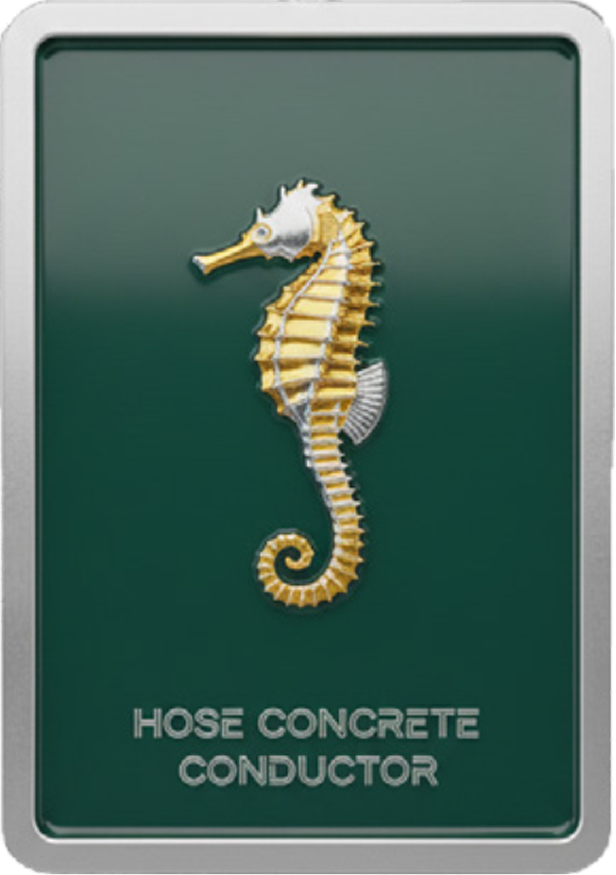
Hose concrete conductor — the use of high-pressure hoses (up to 18 bar) 150mm in diameter and up to 40 meters in length as disposable underwater concrete lines.
Pressurized sewage/DC power/Potable water supply
Framed stacked wall — a method for constructing an underwater wall from a bunch of horizontal HDPE pipes (= hoses) tightly fixed in several frames of the 3D structure. This makes it possible to use pipes in long stock lengths even for relatively short marine terraces
Manifold — fittings for “centralized” concrete casting of several horizontal pipes in a bunch (in a seawall). Also ensure sealing of pipe ends and are used to create 34 right angles in walls.
Fitting System — an innovative method for creating 3D forms from pipes with circular sections and diameters over 5”. Replacing “pipe-pipe” connections to “pipe fitting” connections in a structure fully eliminates the need for labor-intensive forming of pipe edges and significantly reduces the accuracy required for cutting them lengthwise.

Innovative formats:
DUNE — a method of coastal protection and restoration of sandy beaches using terraced seawalls.
Zero Line — a method for setting up mooring spaces for small boats and resort communities in shallow waters without any moles, which helps retain free access to the coastline and normal water circulation in the bay.
SeaVillage — a compact settlement designed for recreational and athletic purposes at the zero line and combined with camping and collective parking space for small bots [a mix of dry and wet berths]
BoatCondo — structures designed for dry storage of two and more boats above water. This collective storage helps save up on up to 30-50% of the fittings and pipes (common wall effect) and at the same reduce the occupied water area..

our product line also includes
-
Terraced support walls.
-
Terraced beaches
-
Gabions
-
Sea causeways
-
Boat condos
-
Wet garages
-
Deep-water boat ramps
-
Sea camping
-
Wheeled lifts
Innovative formats:
The private marine construction market is still dominated by technologies used in Ancient Greece and Medieval Venice: stilts hammered (vibropiled) into soft sea ground and embankments, and foundations from large log crates filled with big rocks (essentially gabions). Obviously, it is impossible to create a stylish brand around hammering wooden or steel stilts. Neither the raw materials (logs), nor the technology employed for this 7 leave any space for patents, know-hows, or price edge.
One of the more recent technologies of note is steel or PVC Larssen sheet piling. However, even Larssen sheet piling was invented in 1906. Technically, it is just sheets with indentations and locks that can be put together into a seawall. In many cases, it is still cheaper
to simply hammer in
(or wash) a row of wooden
stilts put close together.
BoatCondo — structures designed for dry storage of two and more boats above water. This collective storage helps save up on up to 30-50% of the fittings and pipes (common wall effect) and at the same reduce the occupied water area..

The main characteristics of modern private marine construction are:
Primitive materials (logs or steel pipes).
Structure costs very commonly including machine hours of heavy machinery (that must work continuously for weeks) and qualified labor of excavator operators, crane operators, flatbed drivers, or barge captains.
Large business entry investments (up to $200,000 per team.)
Duration of work being highly dependent on the weather. 95% of all “wet” work is done on-site and above water only.
A lot of raw-material waste due to bottom geology and the impossibility to cut the material perfectly
50% of water areas having prominent seasonality, rendering winter work impossible.
Construction teams being able to work only within 100-150 km radius from their base.
As a result, neighbors will be suffering through unbearable noise and diesel fumes, and the structure will have a short service life and will soon require repairs.
All these factors make business scaling ineffective, as there is practically no opportunity to save on the size and nothing for the extra workers to do in winter
This is how Hydrantula’s technology revolutionizes the workflow for private marine construction:
At least 50% of all operations (and sometimes even up to 90%) are done in a shop. 8 Shops also make it possible to produce semi-manufactured products during winter for storage.
Semi-manufactured and ready-made products can be transported on lowbed trucks across thousands of kilometers.
Most workers can be trained from scratch within a week. They will not need prior heavy machinery certification.
Involvement of heavy machinery is reduced to 1-2 days (or by 5-7 times).
Initial tool investments can be brought down to $5,000 for the team (dealer).Work at the installation site generate practically no noise.
Service life of Hydrantula structures is up to 60 years.
Wasted material is no more than 10%
At the same time, the structures are one-of-a-kind in appearance. Creating a strong brand is a relatively simple marketing task. The technology is protected by several international patents and trademarked.


